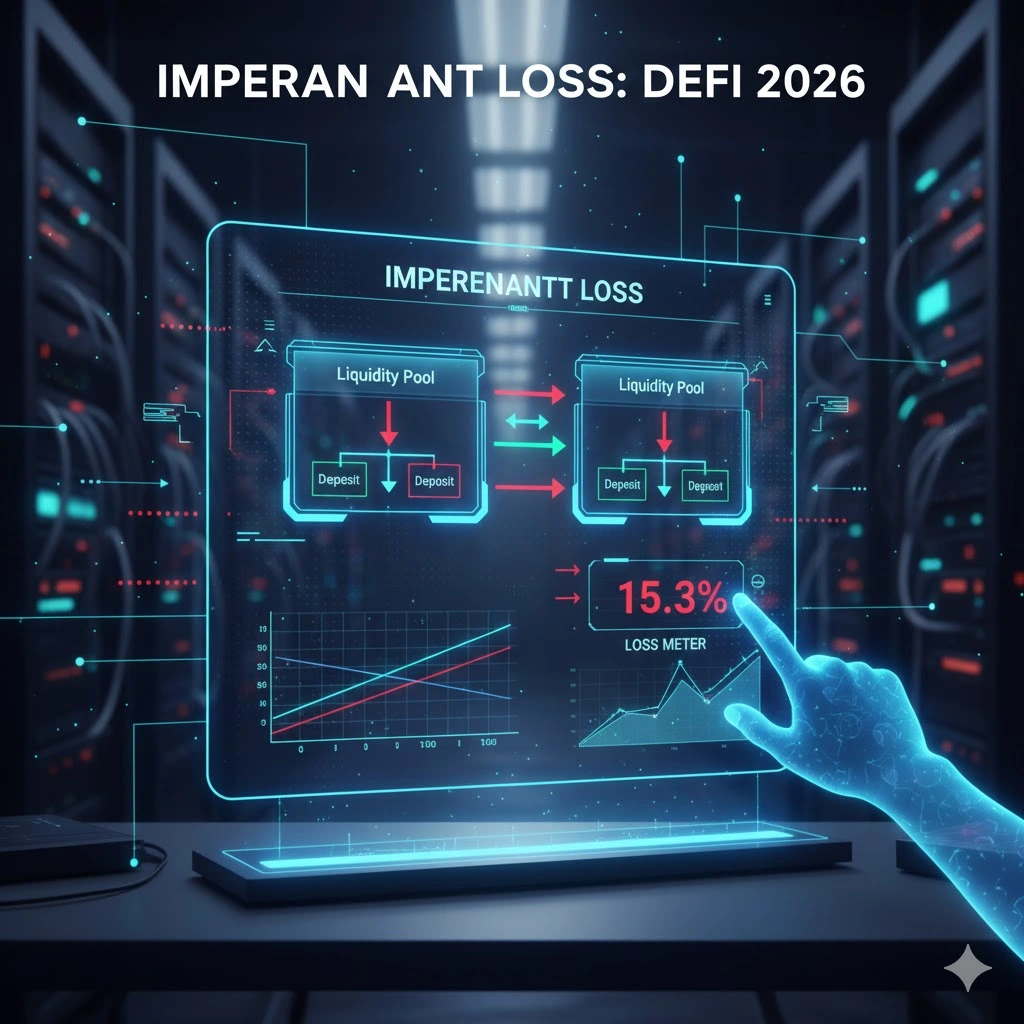
Thinking about earning passive income by providing liquidity to DeFi pools? Before you deposit, you need to understand impermanent loss — the hidden cost that can turn your "yield farming" into actual losses. Use our Impermanent Loss Calculator to see the real numbers.
What is Impermanent Loss?
Impermanent Loss (IL) is the difference in value between holding tokens in your wallet versus depositing them into an AMM liquidity pool. When token prices change relative to each other, you end up with less value than if you had simply held.
Warning
The "Impermanent" Trap
It's called "impermanent" because the loss disappears if prices return to the original ratio. But in practice:
- Prices rarely return to the exact same ratio
- When you withdraw, the loss becomes permanent
- Trading fees don't always cover the loss
Calculate before you provide liquidity: IL Calculator
How Impermanent Loss Works
Let's walk through a concrete example:
You deposit into an ETH/USDC pool:
├── 1 ETH worth $2,000
├── + 2,000 USDC
└── Total value: $4,000

Pool ratio: 50% ETH / 50% USDC

One month later, ETH rises to $4,000:

If you just HELD:
├── 1 ETH = $4,000
├── 2,000 USDC = $2,000
└── Total: $6,000

In the POOL (after rebalancing):
├── 0.707 ETH = $2,828
├── 2,828 USDC = $2,828
└── Total: $5,656

Impermanent Loss: $6,000 - $5,656 = $344 (5.7%)
You made money ($5,656 > $4,000), but you made LESS than if you had just held.
Impermanent Loss Calculator
Don't guess — calculate your exact IL:
Tip
Free Impermanent Loss Calculator
Enter:
- Token A and Token B amounts
- Current prices
- Future/changed prices
See your exact impermanent loss in dollars and percentage.
Impermanent Loss by Price Change
The IL formula is mathematical and predictable:
| Price Change | Impermanent Loss | Notes |
|---|---|---|
| 1.25x (+25%) | 0.6% | Minor |
| 1.50x (+50%) | 2.0% | Noticeable |
| 2x (+100%) | 5.7% | Significant |
| 3x (+200%) | 13.4% | Major |
| 4x (+300%) | 20.0% | Severe |
| 5x (+400%) | 25.5% | Extreme |
Key insight: IL is the same whether the price goes UP or DOWN. A 2x increase OR a 50% decrease both cause 5.7% IL.
The Math Behind Impermanent Loss
For those who want to understand the formula:
IL = 2 × √(price_ratio) / (1 + price_ratio) - 1

Where:
price_ratio = new_price / old_price

Example (2x price increase):
IL = 2 × √2 / (1 + 2) - 1
IL = 2 × 1.414 / 3 - 1
IL = 0.943 - 1
IL = -0.057 = -5.7%
Or just use our calculator and skip the math.
When Does IL Become Permanent?
Impermanent loss becomes permanent when:
- You withdraw at different prices than when you deposited
- One token goes to zero (rug pull, project failure)
- You never withdraw and prices never return
The "impermanent" name is somewhat misleading — for most LPs, the loss is very much real.
Real-World IL Examples
Example 1: Bull Market LP (Lost Gains)
January 2025:
├── Deposited: 1 ETH ($2,000) + 2,000 USDC
└── Total: $4,000

December 2025 (ETH at $4,000):
├── If held: $6,000
├── In pool: $5,656
├── Impermanent Loss: $344 (5.7%)
├── Trading fees earned: +$200
└── Net result: $5,856 (-$144 vs holding)

Verdict: Would have been better off just holding ETH
Example 2: Stable Pool (Minimal IL)
USDC/USDT Pool:
├── Deposited: 5,000 USDC + 5,000 USDT
└── Total: $10,000

After 1 year:
├── Price ratio unchanged (both stablecoins)
├── Impermanent Loss: ~0%
├── Trading fees earned: +$500 (5% APY)
└── Total: $10,500

Verdict: Stablecoin pools avoid IL but have lower yields
Example 3: Rug Pull (100% Loss)
Deposited: 1 ETH ($2,000) + 2,000 SHITCOIN
Total: $4,000

SHITCOIN rugs to $0:
├── Pool rebalances automatically
├── You end up with ~0.001 ETH + millions of worthless SHITCOIN
└── Total value: ~$2 (99.95% loss)

Verdict: IL becomes infinite when one token goes to zero
DeFi Protocols and IL
Uniswap V2/V3
| Version | IL Risk | Capital Efficiency |
|---|---|---|
| V2 | Standard IL | 1x (full range) |
| V3 | Higher IL (concentrated) | Up to 4000x |
Uniswap V3 note: Concentrated liquidity earns more fees but has HIGHER IL risk because you're exposed to a narrower price range.
Curve Finance
Optimized for stable pairs:
- USDC/USDT/DAI pools: Near-zero IL
- ETH/stETH pools: Minimal IL (correlated assets)
- Best for: Stablecoin yield with low risk
PancakeSwap
Similar to Uniswap but on BNB Chain:
- Lower gas fees
- Same IL mechanics
- Higher APYs often = higher IL risk
Balancer
Multi-asset pools with custom weights:
- 80/20 pools reduce IL on the majority token
- More complex but can optimize IL exposure
Strategies to Minimize Impermanent Loss
1. Provide Liquidity to Stable Pairs
Low IL pools:
├── USDC/USDT (stablecoin pairs)
├── ETH/stETH (liquid staking derivatives)
├── WBTC/renBTC (wrapped BTC variants)
└── DAI/USDC (stablecoins)
2. Choose Correlated Assets
Assets that move together have less IL:
- ETH/WETH (identical)
- BTC/WBTC (near identical)
- Blue chips that tend to move with BTC
3. Short Duration LPing
Strategy:
├── Provide liquidity for high-fee events
├── Withdraw after the event
└── Minimize time exposed to price changes

Example: Airdrop farming, new token launches
4. Use Single-Sided Staking
Some protocols allow single-asset deposits:
- No IL risk (but lower returns)
- Examples: Bancor V3, some Curve gauges
5. Delta-Neutral LP
Advanced strategy for professionals:
1. Deposit into ETH/USDC pool
2. Short ETH on a futures exchange
3. Hedge IL with the short position
4. Collect fees while neutralizing directional exposure

Pros: Eliminates IL
Cons: Complex, margin requirements, funding costs
IL vs Trading Fees: The Breakeven Analysis
Before LPing, calculate if fees will cover IL:
Example calculation:

Expected price change: 2x (100% increase)
Expected IL: 5.7%

Pool APY from fees: 20%
LP duration: 6 months
Expected fees: 10%

Profit if held: 100% (from price increase)
Profit in pool: 100% - 5.7% + 10% = 104.3%

Result: LP slightly better (4.3% advantage)

BUT: If price goes 3x, IL = 13.4%
Pool result: 200% - 13.4% + 10% = 196.6%
Holding result: 200%

Result: Holding wins at higher price increases
General rule: The higher the expected price movement, the worse LPing performs vs holding.
Impermanent Loss vs Other DeFi Risks
| Risk | Description | Mitigation |
|---|---|---|
| Impermanent Loss | Value loss from price divergence | Stable pairs, short duration |
| Smart Contract Risk | Code bugs, exploits | Use audited protocols only |
| Rug Pulls | Project abandons/scams | Avoid new, unaudited tokens |
| Oracle Manipulation | Price feed attacks | Use protocols with Chainlink |
| Regulatory Risk | Government crackdowns | Diversify across jurisdictions |
Should You Provide Liquidity?
✅ LP Makes Sense If:
- You're providing to stable pairs (USDC/USDT)
- You believe both tokens will stay relatively stable
- Pool APY is significantly higher than IL risk
- You're an advanced user who understands the risks
- You want exposure to both tokens anyway
❌ Better to Just Hold If:
- You're bullish on one token (it will likely outperform)
- You're new to DeFi
- You can't monitor positions regularly
- Pool APY is low (<10% for volatile pairs)
- You don't understand IL fully
The Simpler Alternative: DCA
For most users, DCA (Dollar-Cost Averaging) is simpler and often more profitable:
| Factor | Liquidity Providing | DCA |
|---|---|---|
| Impermanent Loss | Yes | None |
| Smart Contract Risk | Yes | None (for CEX) |
| Complexity | High | Very Low |
| Time Required | Monitoring needed | 15 min/week |
| Passive Income | Yes (fees) | No (only appreciation) |
| Historical Returns | Varies widely | Positive for BTC/ETH |
Calculate DCA returns: DCA Calculator
FAQ
Conclusion
Impermanent loss is a real risk that every DeFi user must understand:
- ✅ Calculate IL before providing liquidity: IL Calculator
- ✅ Start with stable pairs to learn with minimal IL
- ✅ Compare expected fees vs expected IL
- ✅ Never LP with tokens you haven't researched
- ✅ Consider if simple holding or DCA might be better
Not sure about DeFi? Try our DCA Calculator for a simpler wealth-building approach.
This article is for educational purposes only. DeFi involves significant risks including smart contract bugs, impermanent loss, and total loss of funds. Always do your own research and never invest more than you can afford to lose.
Last updated: January 2026